Timeline
From project definition to final presentation in 8 weeks.
Background
At Alteryx, a major strategic challenge was the transition from a legacy on-premise data analytics software to a unified Cloud-based platform.
Goal
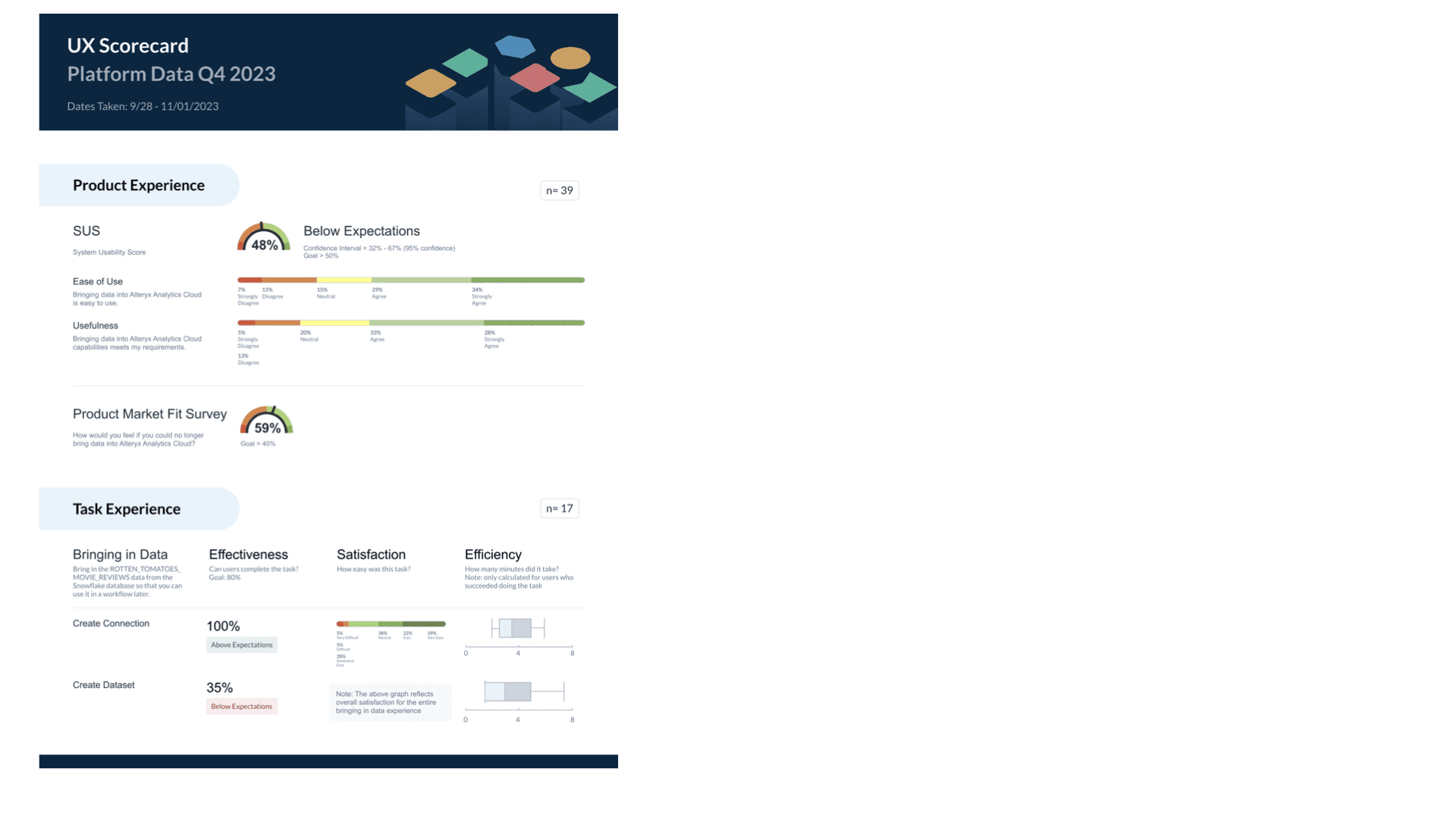
Establish a standardized, repeatable framework to measure and communicate the user experience health of the Alteryx Cloud platform.
Critical Barriers
Fragmented Data: Insights existed in silos across various product teams.
Strategic Stalls: A lack of clear UX benchmarking made it difficult to justify prioritizing foundational usability fixes.
The "What" vs. the "Why": While telemetry showed drop-offs, the business lacked a systematic way to explain the underlying friction and its impact on long-term adoption.
Approach
The research was designed to provide an in-depth look at the platform’s health by capturing both how users perceive the product and how they actually perform within it.
Intercept Surveys: We collected feedback from 40 active Alteryx Cloud users via on-platform intercepts. This allowed us to measure real-time perceptions of usability and product-market fit from users naturally engaged with the platform.
Unmoderated Usability Testing: We ran sessions with 20 participants, including a mix of current customers and external data professionals recruited through a third party. They were tasked with completing high-priority onboarding workflows to identify specific functional friction.
Data Synthesis: By combining these qualitative insights with existing analytics and past research, we developed a comprehensive picture of where the platform was succeeding and where it was falling short for new and existing users.
The Scorecard became the "source of truth" for the platform’s UX health, moving research from a tactical service to a strategic driver.
Key insights
Work-Led Influence: By aligning UX metrics with business KPIs, research became "undeniable," leading to direct invitations to C-suite sessions.
Productive Disruption: Identifying "D" and "F" grades helped the business realize the "Cost of Inaction" regarding technical debt.
Outcomes
Unblocked Strategy: Used as a primary tool to justify a shift in the roadmap toward fixing foundational cloud onboarding friction.
Organizational Literacy: Established a shared vocabulary across 10+ product teams for what "Good" looks like.
Governance at Scale: Created a sustainable model where PMs and Designers were accountable for maintaining UX grades.


Increased Efficiency
Users report significant time savings and improved productivity through optimized scheduling recommendations.
Positive User Feedback
High user satisfaction ratings and positive reviews highlight the app's intuitive interface and powerful AI capabilities.
Growing User Base
The app quickly gained traction among individuals and businesses worldwide, with a steady increase in user adoption and engagement.