
Overview
Reactivated a stalled UX strategy and increased customer satisfaction scores by 10%.
Background
Alteryx was transitioning from legacy on-premise software to a unified cloud-based platform. While the company grew through a loyal base of non-analysts using visual data blocks, this "shadow IT" market had stagnated. To compete, Alteryx had to diversify its customer base and evolve its UX.
Goal
Establish a standardized, repeatable framework to measure and communicate the user experience health of the Alteryx Cloud platform. The stated goal was to gauge the usability of bringing in data to the platform.
Hypotheses
This fragmentation made prioritizing resources difficult. To address this, the UXR team developed UX Scorecards. These provided a single source of truth and unbiased benchmarks across the portfolio, allowing leaders to identify areas requiring attention and advocate for necessary design changes.
Success Criteria
xxx
Intercept Surveys
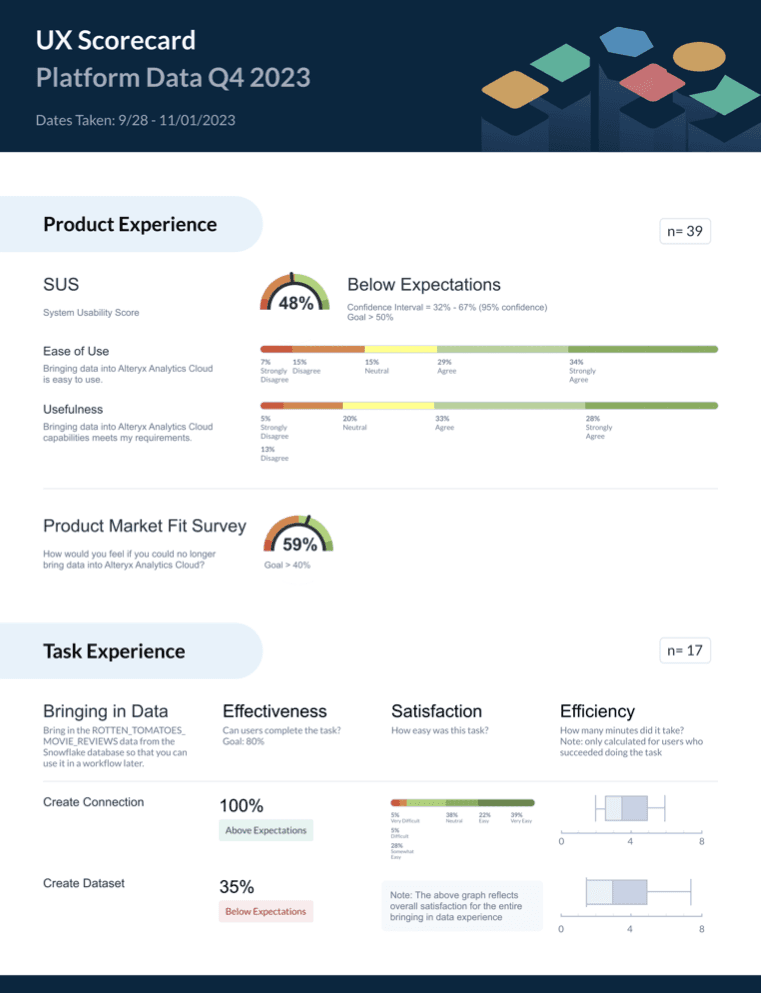
Collected feedback from 40 active Alteryx Cloud users via on-platform intercepts. This allowed us to measure real-time perceptions of usability and product-market fit from users naturally engaged with the platform.
Unmoderated Usability Testing
Ran sessions with 20 participants, including a mix of current customers and external data professionals recruited through a third party. They were tasked with completing high-priority onboarding workflows to identify specific functional friction.


Critical Usability Gap
Surfaced a 48% System Usability Score (SUS), identifying a disconnect where users valued the tool's power but struggled with task navigation.
Site architecture clunky and did not support user in the key tasks
Validated PMF
Achieved a 59% Product Market Fit score, significantly exceeding the 40% industry benchmark and confirming high demand for cloud data capabilities.
Roadmap Prioritization
Shifted Q1 and Q2 strategy toward foundational UX debt, providing the evidence required for an architectural transformation (merge "Data" and "Connections" pages), removing a primary structural barrier for users initiating workflows.
Unblocked Strategy: Used as a primary tool to justify a shift in the roadmap toward fixing foundational cloud onboarding friction.
Organizational Literacy
Established a shared vocabulary across 10+ product teams for what "Good" looks like.